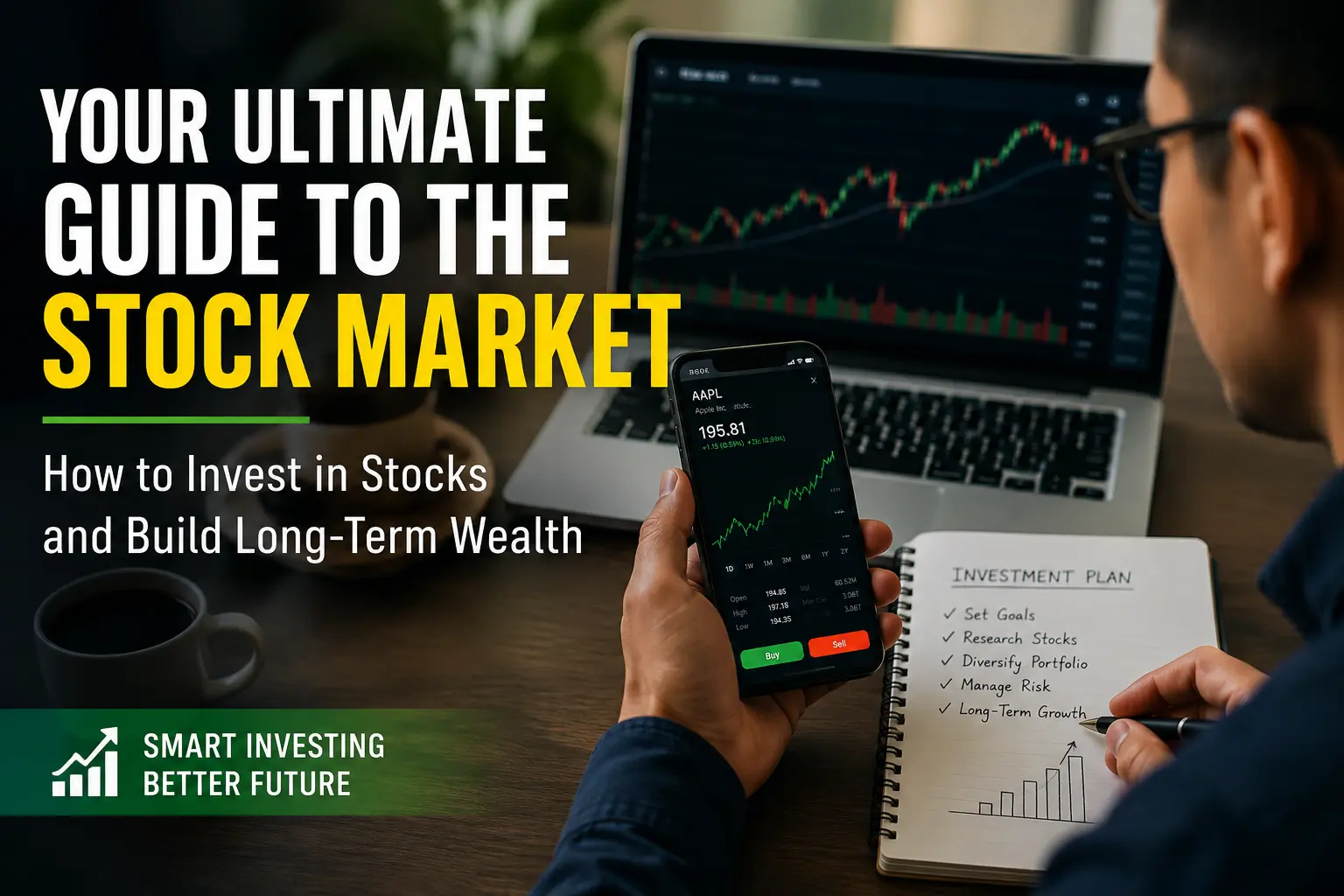
Your Ultimate Guide to the Stock Market: How to Invest in Stocks and Build Long-Term Wealth
You open your banking app and watch the number barely move. Meanwhile friends mention their portfolios growing over years. You wonder if the stock market is only for people who already have money or somehow know secret codes. Spoiler: it is not. I started with small automatic transfers years ago when I still felt clueless. Those early shares turned into something real because time and consistency did the heavy lifting.
This guide walks you through exactly how the stock market works, how to invest in stocks the smart way, and how regular people build long-term wealth without needing to become day traders. No complicated jargon. Just clear steps and honest lessons from someone who has made the usual beginner mistakes.
What the Stock Market Actually Is
The stock market is simply a place where people buy and sell tiny pieces of public companies. When you buy a share, you own a small slice of that business. If the company grows and becomes more valuable, your slice usually grows in value too. Some companies also pay you a portion of their profits as dividends.
Think of it like owning a tiny corner of a successful bakery. You do not run the ovens, but you benefit when the bakery thrives. The stock market just makes it easy to buy and sell those ownership pieces every weekday.
Prices move up and down based on news, earnings, interest rates, and investor mood. Short-term swings can feel wild. Over decades the overall market has historically climbed because companies innovate, expand, and generate more profits. That long-term upward trend is why patient investors win.
Why Stocks Beat Sitting in Cash for Building Wealth
Cash under the mattress or in a low-interest account loses purchasing power to inflation. Stocks have historically returned around 10% per year on average for the broad U.S. market over long periods when you include dividends. That number is not guaranteed every year. Some years are negative. Some decades disappoint. Yet over 20 or 30 years the compounding effect becomes powerful.
I once calculated what would happen if I kept my money in a savings account versus putting it into a simple stock index fund. The difference after 20 years was not subtle. Compounding turns small regular investments into meaningful sums when you give it time.
Ever wonder why financial advisors keep preaching “time in the market beats timing the market”? Because trying to jump in and out usually means missing the best days. Those best days do a lot of the heavy work.
How to Get Started Investing in Stocks
You need three things: a brokerage account, some money you will not need soon, and a simple plan.
Open a Brokerage Account
Most major brokers let you open an account online in about 15 minutes. Popular choices include Fidelity, Vanguard, Schwab, and others. Many charge zero commissions for stock and ETF trades. Fractional shares let you buy a piece of expensive stocks with as little as a few dollars.
Look for:
- No or low account minimums
- Easy mobile app
- Solid customer service
- Access to low-cost index funds and ETFs
I opened my first account with a well-known broker and linked my bank account the same day. The transfer took a couple of business days. After that I could invest anytime.
Decide How Much to Invest
Only invest money you will not need for at least five years, preferably longer. Keep an emergency fund in cash first. Pay off high-interest debt if the interest rate is higher than what you realistically expect from stocks.
Many people start with $50 or $100 per month. Consistency matters more than the starting size. Automatic transfers from your paycheck or bank account remove the need for willpower every month.
Choose the Right Account Type
For long-term goals like retirement, tax-advantaged accounts help:
- 401(k) or similar workplace plan: Contribute enough to get any employer match. That is free money.
- Roth IRA or Traditional IRA: Great for additional retirement savings with tax benefits.
- Taxable brokerage account: Flexible for goals that are not retirement-related.
I max out tax-advantaged accounts first whenever possible. The tax savings compound alongside the investments.
Index Funds and ETFs: The Simple Path Most People Should Take
Picking individual stocks sounds exciting. Researching companies, reading earnings reports, and watching prices can feel productive. For most people it is also a fast way to underperform.
A broad index fund or ETF owns hundreds or thousands of stocks in one package. An S&P 500 fund owns the 500 largest U.S. companies. A total stock market fund owns essentially the entire U.S. market. You get instant diversification and the average market return minus tiny fees.
Why index funds work so well for long-term wealth:
- Extremely low costs (often under 0.05% per year)
- Automatic diversification across many companies and sectors
- No need to research individual businesses constantly
- Historically hard for most active managers to beat after fees
Warren Buffett has repeatedly recommended low-cost S&P 500 index funds for the average investor. I shifted most of my own money into broad index funds years ago and slept better. The individual stock picks I still hold are a small side portion for fun and learning.
Popular low-cost options include funds that track the S&P 500 or the total U.S. stock market. International funds add exposure outside the United States if you want broader diversification.
The Power of Dollar-Cost Averaging
Dollar-cost averaging means investing a fixed amount on a regular schedule regardless of whether the market is up or down. You buy more shares when prices are low and fewer when prices are high. Over time this smooths out your average cost.
I set up automatic monthly investments and mostly ignore the daily noise. Some months I buy when the market feels expensive. Some months I buy during scary drops. Over years the average works in my favor.
This approach removes the pressure of trying to find the perfect entry point. Perfect timing is nearly impossible. Consistent investing is very possible.
Buy and Hold: The Strategy That Actually Builds Wealth
Buy solid investments and hold them for years or decades. Reinvest dividends if you do not need the income. Avoid selling during panics.
Markets drop. Sometimes they drop hard. In 2008 and early 2020 plenty of people sold near the bottom and locked in losses. Those who stayed invested recovered and then grew further. Time heals a lot of temporary pain when you own quality assets.
I have held through multiple corrections. The uncomfortable periods feel shorter when you zoom out to a 10-year or 20-year chart. The long-term direction has been up.
Managing Risk Without Killing Growth
Risk is the chance that your investments lose value, especially when you need the money. You manage it mainly through time horizon and diversification.
- Longer time horizons allow higher stock allocations because you can wait out downturns.
- Diversification across many companies, sectors, and even countries reduces the damage from any single failure.
- Bonds or cash can stabilize a portfolio as you get closer to needing the money.
A simple rule of thumb many people use: subtract your age from 110 or 120 to get a rough stock percentage. A 30-year-old might hold 80-90% stocks. A 60-year-old might hold 50-60%. Adjust based on your personal comfort and goals.
I rebalance once a year. If stocks have run far ahead, I sell a little and buy more of the lagging part to keep the target mix. It forces me to sell high and buy low without emotion.
Common Mistakes That Derail New Investors
Chasing hot tips or last year’s winners. By the time something is popular, a lot of the easy gains may already be priced in.
Checking your account every day and reacting to every dip. This leads to panic selling.
Investing money you need soon. A market drop right before a house down payment can force you to sell at a bad time.
Paying high fees. A 1% annual fee compounds into a huge drag over decades.
Ignoring taxes. Holding investments for over a year usually qualifies for lower long-term capital gains rates in taxable accounts.
I made the daily-checking mistake early on. Turning off notifications and reviewing only monthly or quarterly improved both my results and my mood.
Building a Simple Long-Term Portfolio
Here is a straightforward approach that works for most people:
- Open a brokerage or retirement account.
- Choose one or two broad low-cost index funds or ETFs (U.S. total market or S&P 500 plus international if desired).
- Set up automatic monthly investments.
- Reinvest dividends.
- Increase the contribution amount whenever your income rises.
- Leave it alone for years.
You can add a small “fun money” portion for individual stocks if you enjoy the research. Keep it to 5-10% so mistakes stay limited.
This boring approach has created more wealth for ordinary people than most fancy strategies.
Taxes, Fees, and the Quiet Killers of Returns
Fees compound against you. Always prefer low-cost funds. A difference of 0.5% per year looks small but becomes massive over 30 years.
In taxable accounts, holding periods matter. Long-term capital gains rates are usually lower than ordinary income rates. Tax-advantaged accounts shelter growth entirely or defer taxes.
I track cost basis and holding periods so I do not create unnecessary tax bills. Simple record-keeping prevents surprises.
Staying the Course When Markets Get Scary
Every investor eventually faces a big drop. The ones who succeed treat those periods as temporary. They keep investing if they can and avoid locking in losses by selling.
History shows recoveries happen. The companies that make up the market adapt, innovate, and grow again. Your job is to own a piece of that growth and give it time.
I remind myself that volatility is the price of admission for higher long-term returns. Bonds and cash feel safer short-term but usually lag over decades.
Putting It All Together
The stock market rewards patience, consistency, and low costs more than cleverness. Open an account. Invest regularly in broad index funds. Hold for the long term. Increase contributions as you can. Ignore most of the daily noise.
I still check my accounts less often than I used to. The less I tinker, the better the results tend to look years later. Building long-term wealth through stocks is less about finding the next big winner and more about not interrupting the compounding process.
Start with whatever amount feels comfortable this month. Set the automatic transfer. Give it years to work. Your future self will thank you when the account balance reflects decades of quiet, steady progress rather than a series of emotional decisions.
The market will keep moving. Your plan does not have to. Keep it simple, stay consistent, and let time do what it does best.
Read more: Best Dividend Stocks for Beginners (2026): Top Picks for Passive Income
Tools website: Fybos.com
Tags: stock market, stock market investing, how to invest in stocks, investing in stocks, stock market for beginners, stock investing, investing for beginners, how to make money in stocks, long term investing, build wealth through stocks, how to invest in stocks for beginners, best way to invest in stocks, how to start investing in stocks, how to invest in the stock market, stock market investing for beginners, best stocks for long term investment, long term stock market investing, how to build wealth with stocks, stock market wealth building, how to become a successful stock investor, stock investing strategies, stock market investment strategy, beginner stock market strategy, how much money do you need to invest in stocks, how to buy stocks for beginners